
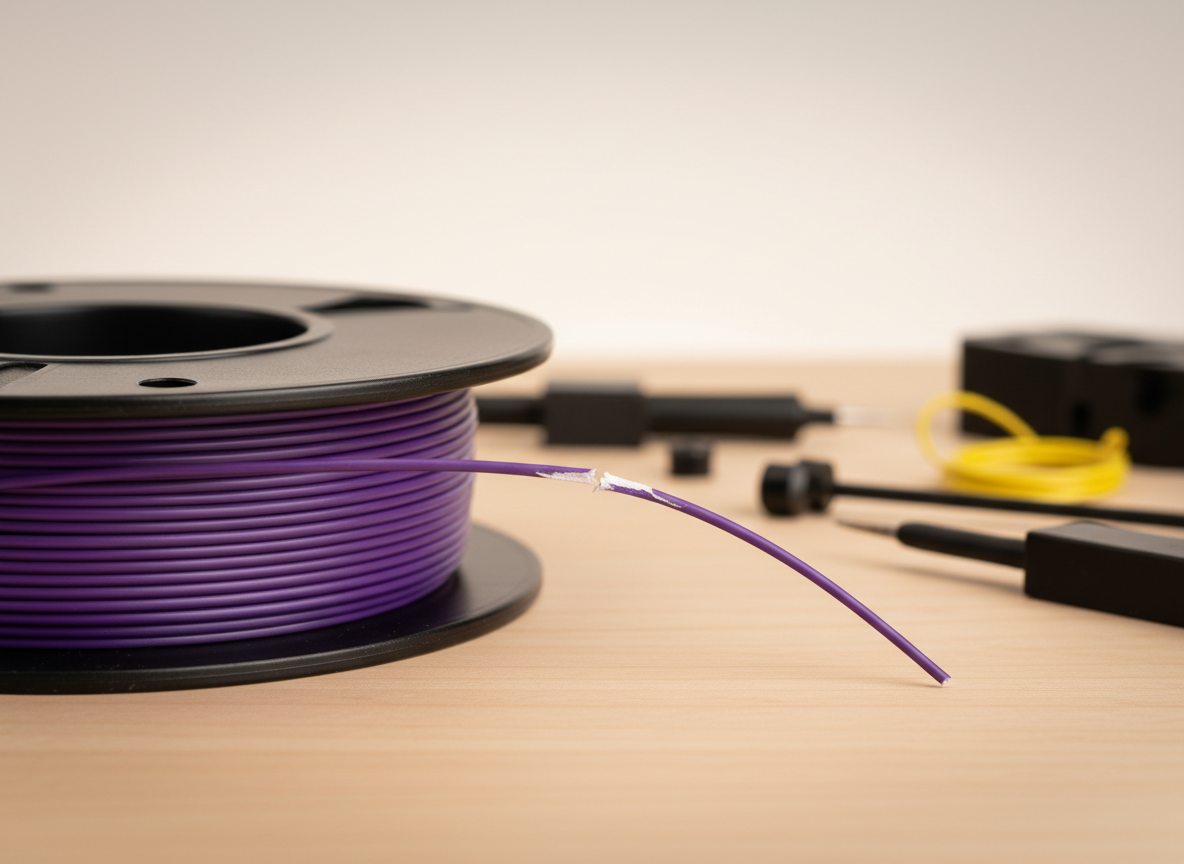
BRITTLE FILAMENT REPORT
Filament that snaps on the spool, in a dry box or before the extruder is frustrating—but brittle filament is not automatically wet filament. The break location, material type and storage history tell you more than the symptom alone.
QUICK VERDICT
Breaks everywhere
If many sections of the spool feel brittle, material condition and storage history deserve more attention.
Breaks at one point
If snapping repeats at the same guide, bend or entry point, mechanical stress and feed-path geometry are stronger first suspects.
Start with where it breaks
| What you see | What to investigate first |
|---|---|
| Snaps while sitting curved on the spool or PTFE path | Material condition, long exposure, aging and storage history |
| Breaks repeatedly at one sharp guide or entry point | Feed-path friction, bend radius and spool alignment |
| Only one damaged section breaks | Kinks, winding damage or local mechanical stress |
| Brittle across many sections of the spool | Material condition and storage deserve closer attention |
Moisture vs mechanical stress
MOISTURE BECOMES MORE PLAUSIBLE
- Snapping appears across many sections
- The spool has credible humid exposure
- Popping or bubbly extrusion also appears
- Surface quality has degraded at the same time
MECHANICAL STRESS BECOMES MORE PLAUSIBLE
- Breaks repeat at the same guide or sharp bend
- The spool does not unwind cleanly
- Only a kinked or damaged segment fails
- No other moisture clues appear at the nozzle
BEND TEST LIMIT
The bend test is only a clue
A hand bend test can help compare sections of the same spool, but it is not a universal pass/fail rule. Material formulation, diameter, temperature and bend radius all change the result.
Better diagnostic order
- Identify the material and exact product.
- Inspect where the breaks happen and whether they repeat at the same guide or bend.
- Check how long the spool has been open and how it was stored.
- Look for other moisture clues at the nozzle.
- If moisture remains plausible, use product-specific drying guidance and compare afterward.
- If breakage remains localized, fix the mechanical stress instead of repeatedly drying the spool.
Do not diagnose moisture from snapping alone.
The break pattern tells you whether to investigate the spool condition or the feed path first.
Source
Prusa — Drying filament. Checked September 13, 2026.