
Nylon is one of the clearest examples of why filament drying should be product-specific. PA6, PA11, PA12 and reinforced blends can all behave differently, so the useful question is not “what temperature for nylon?” but “what does the exact product manufacturer require?”
MATERIAL REPORT · VERIFIED EXAMPLES
PA6-CF
Bambu: 80 °C · 8–12 h before printing.
PA11-CF
Prusa: 90 °C · 6 h in its drying table.
PA11 Natural
Prusa: ideally 90 °C · 6–8 h.
Key point: these are different products, not conflicting answers to one universal nylon rule.
Manufacturer data at a glance
| Product / source | Drying guidance | Storage / handling |
|---|---|---|
| Bambu PA6-CF | 80 °C for 8–12 h before printing | <20% RH while printing/keeping; sealed with desiccant |
| Prusament PA11 Carbon Fiber | 90 °C for 6 h in Prusa’s drying table | Dry-box storage recommended in Prusa guidance |
| Prusament PA11 Natural | Ideally 90 °C for 6–8 h before printing | Dry-box storage slows moisture absorption afterward |
Why the numbers differ
Bambu PA6-CF and Prusament PA11 are not the same formulation simply because both belong to the polyamide family. FilamentFix keeps the product identity attached to the drying value instead of flattening everything into one “nylon” number.
When moisture becomes a strong suspect
Sound clues
Popping or crackling during extrusion strengthens the moisture hypothesis.
Surface clues
Bubbles, rough extrusion or surface quality that degrades after exposure can point toward filament condition.
History clues
Quality that declines after days or weeks outside controlled storage is stronger evidence than one isolated bad print.
Safe nylon drying protocol
01 · IDENTIFY
Confirm PA6, PA11, PA12 or the exact reinforced grade and product name.
02 · VERIFY
Read the current manufacturer or TDS instruction and check spool heat limits.
03 · DRY
Follow both temperature and duration. Do not assume hotter means faster or safer.
04 · RETEST
Repeat the same print with unrelated slicer settings unchanged.
How to verify that drying actually helped
| Observation after drying | What it suggests |
|---|---|
| Popping and bubbles reduce strongly | Moisture was likely contributing |
| Surface becomes more consistent | Supports a filament-condition cause |
| Stringing improves but remains | Moisture may have contributed; tuning may still matter |
| No meaningful change | Investigate nozzle, flow, temperature and mechanics instead of repeated drying |
Storage after drying
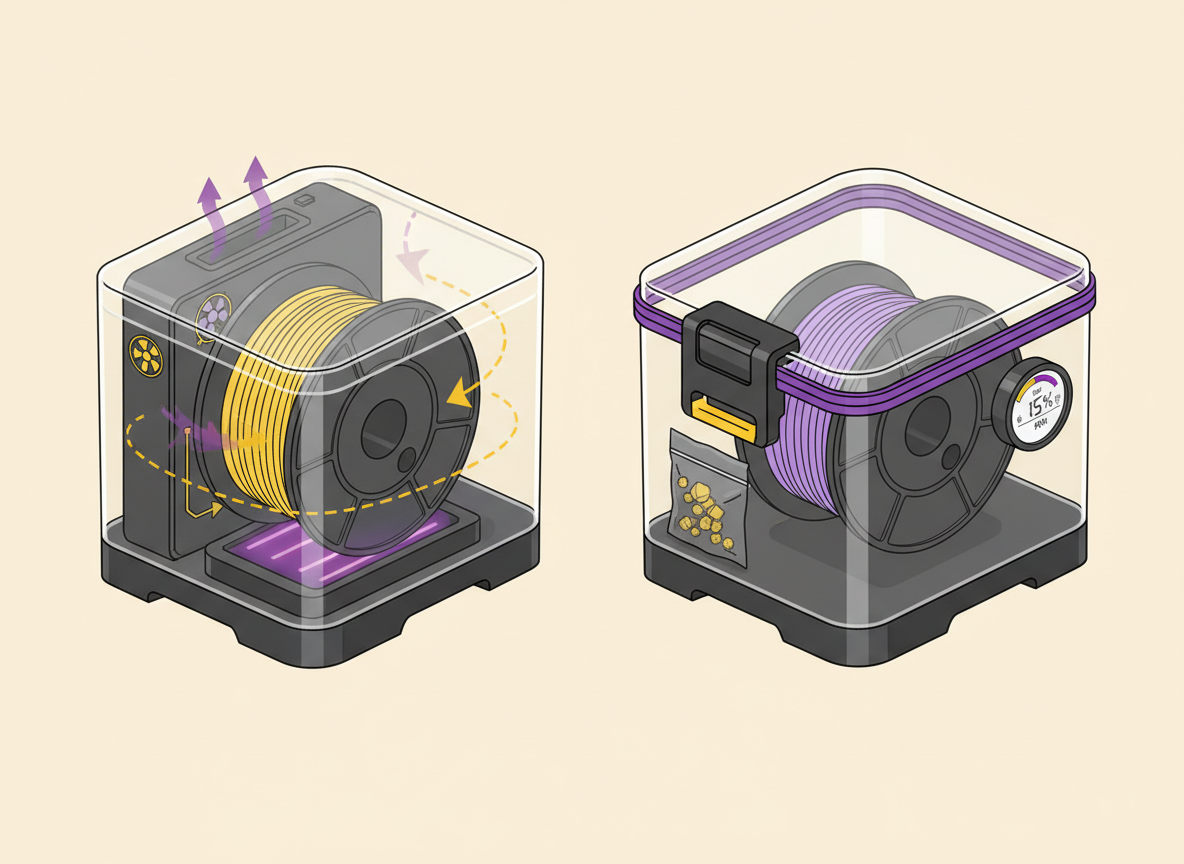
Drying is only half the workflow. Moisture-sensitive PA can reabsorb water after it leaves the dryer. Bambu specifies sealed storage with desiccant and below 20% RH for PA6-CF. Prusa recommends keeping PA11 products in a dry box to slow renewed absorption.
Nylon is a product-data problem, not a single-number problem
If the exact nylon product is missing from the Verified Filament Library, FilamentFix would rather mark the value unknown than borrow a number from a different PA formulation.
Frequently asked questions
What temperature should I dry nylon at?
There is no safe universal answer. Current manufacturer examples differ: Bambu PA6-CF lists 80 °C for 8–12 hours, while Prusa PA11 products publish 90 °C with product-specific durations.
Should nylon stay in a dry box while printing?
For highly moisture-sensitive products, controlled storage during printing can be useful and some manufacturers explicitly recommend it. Follow the exact product guidance.
Official references: Bambu Lab — PA6-CF · Prusa — Drying filament · Prusa — PA11 Natural. Checked September 14, 2026.