
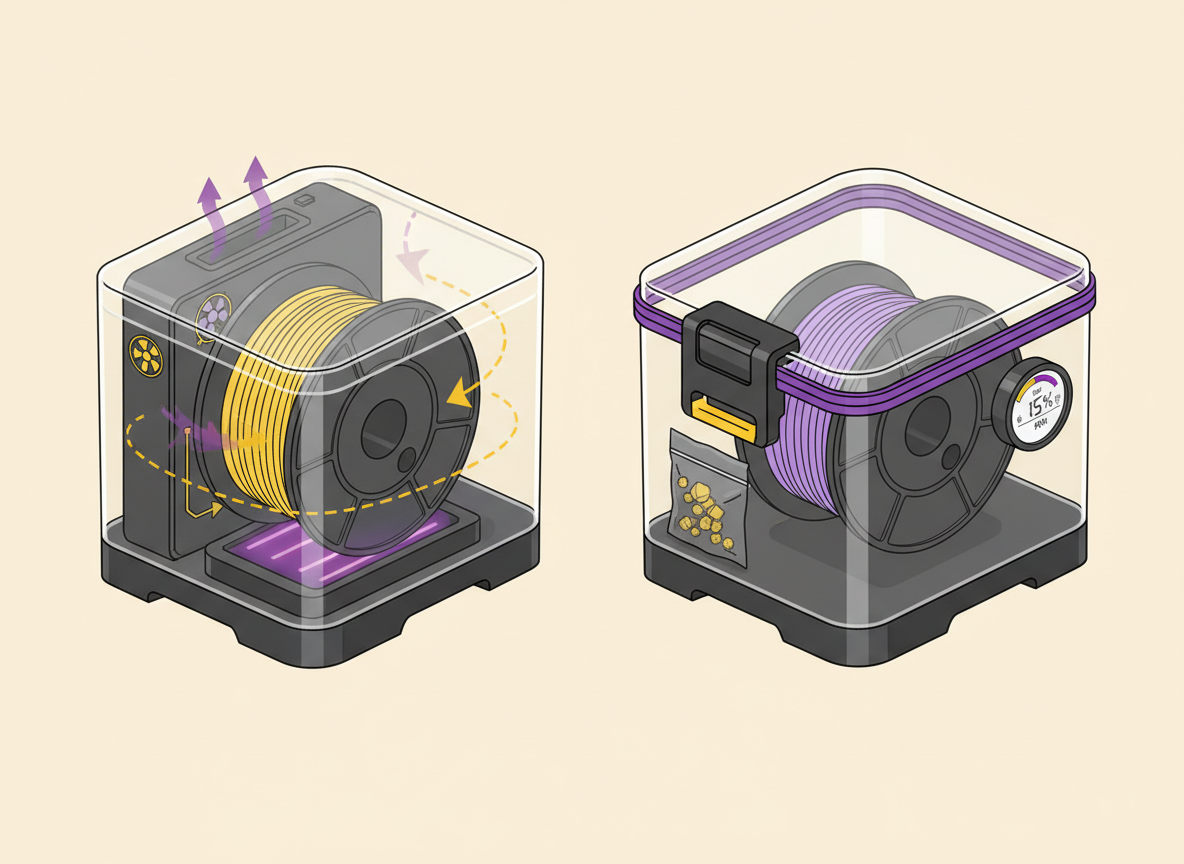
TPU can absorb moisture, but there is no single drying temperature and duration that safely represents every TPU product. Formulation, hardness, additives and spool construction all matter.
TPU REPORT · MANUFACTURER SNAPSHOT
Prusament TPU 95A
60 °C · at least 4 h when moisture has been absorbed.
PolyFlex TPU90 product page
50 °C · 6 h in the current technical-spec area.
PolyFlex TPU90 Wiki/TDS
70 °C · 8 h on the current Polymaker Wiki/TDS page.
CONFLICT ALERT
Polymaker publishes two different current values for PolyFlex TPU90
The product page shows 50 °C for 6 h, while the Wiki/TDS page shows 70 °C for 8 h. FilamentFix treats this as an unresolved manufacturer-source conflict instead of choosing or averaging the values.
Current manufacturer examples
| Product / source | Drying guidance | FilamentFix status |
|---|---|---|
| Prusament TPU 95A | At least 4 h at 60 °C when moisture has been absorbed | Verified exact-product example |
| PolyFlex TPU90 product page | 50 °C for 6 h | Current product-page value |
| PolyFlex TPU90 Wiki/TDS | 70 °C for 8 h | Conflicts with the product page |
When TPU actually needs drying
Popping / crackling
Repeated noise during extrusion is a stronger moisture clue than stringing alone.
Bubbles / unstable extrusion
Visible bubbling or disturbed extrusion strengthens the case for checking filament condition.
Storage history
A spool that printed well and then degraded after poor storage gives the moisture hypothesis more weight.
Safe TPU drying protocol
01 · IDENTIFY
Confirm the exact TPU product, not only hardness or “flexible filament.”
02 · VERIFY
Check the current manufacturer page/TDS and the spool heat limit.
03 · DRY
Use controlled equipment and do not raise temperature just to shorten the cycle.
04 · RETEST
Repeat the same print before changing retraction, speed or temperature.
How to tell whether drying helped
| Before vs after | Interpretation |
|---|---|
| Popping / bubbles drop clearly | Moisture was likely contributing |
| Stringing improves but does not disappear | Moisture may have contributed; tuning can still matter |
| No meaningful change | Stop drying repeatedly; investigate feed path, temperature and retraction |
| Flexible filament buckles or feeds poorly | Mechanical path, speed or extruder geometry may be the bigger issue |
TPU storage matters after drying
Prusa’s USS Drybox guidance lists below 20% RH for TPU in that system, ideally below 15%. Treat those values as system-specific references rather than a universal standard for every TPU and every hygrometer.
Do not confuse wet TPU with difficult TPU feeding
Soft TPU can buckle, bind or feed inconsistently even when dry. Use moisture clues together with feed-path behavior before deciding that drying is the next test.
Frequently asked questions
What temperature should I dry TPU at?
Use the exact product’s current manufacturer instruction. Current official examples differ, and Polymaker TPU90 even has conflicting values across its own current pages.
Does TPU need to be dried before every print?
No. Some manufacturers say drying is only needed after moisture absorption. Diagnose from storage history and symptoms rather than turning drying into a ritual.
Official references: Prusa — Prusament TPU 95A · Polymaker — PolyFlex TPU90 product page · Polymaker Wiki — PolyFlex TPU90. Checked September 14, 2026.