
STORAGE COMPARISON REPORT
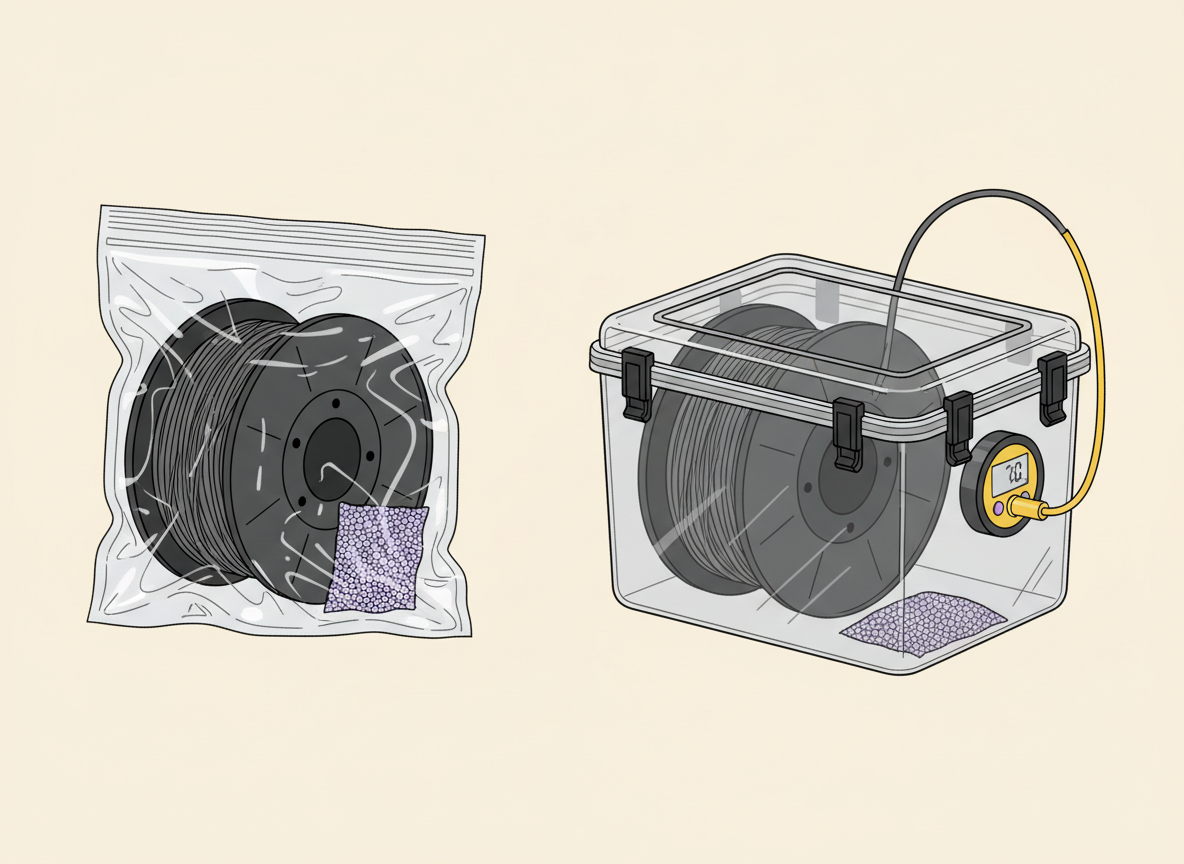
Both methods can reduce exposure to ambient humidity. The key difference is workflow: a vacuum bag is compact storage; a dry box can support monitoring and printing directly from a controlled environment.

QUICK VERDICT
Vacuum bag
Best when compact, low-cost storage matters more than live monitoring or print-through use.
Dry box
Best when you want a repeatable low-humidity environment, visible monitoring and direct printing from storage.
Important: neither option should be treated as active drying for a spool that is already wet.
Dry box vs vacuum bag at a glance
| Factor | Vacuum bag | Dry box |
|---|---|---|
| Space efficiency | Excellent | Uses more space |
| Desiccant | Recommended | Recommended |
| Humidity monitoring | Possible but less convenient | Easy with a hygrometer |
| Print directly from storage | Usually no | Often yes |
| Best use | Longer-term or compact storage | Frequent printing and humidity control during use |
FUNCTION CHECK
What both methods do well
Prusa recommends closed storage with desiccant and explicitly lists vacuum bags as a popular storage option. Both approaches are about limiting additional moisture uptake.
What neither should be assumed to do
A passive dry box or vacuum bag is not the same as active drying. Prusa’s USS Drybox documentation states that the box slows moisture absorption but does not dry a wet spool.
Choose by workflow
VACUUM BAG FIT
- You store many spools and space matters.
- You are not printing from the spool while it is stored.
- You want a low-cost way to limit ambient exposure.
- You are comfortable checking or regenerating desiccant manually.
DRY BOX FIT
- You print frequently from moisture-sensitive materials.
- You want humidity visible at a glance.
- You want to feed filament directly to the printer.
- You want a more repeatable workflow than opening bags repeatedly.
A better storage decision path
01 · CONDITION
Make sure the spool is already in good condition or dry it first if needed.
02 · WORKFLOW
Decide whether the spool will sit idle or be printed directly from storage.
03 · MONITOR
Choose the method that makes maintaining desiccant and checking humidity realistic for you.
Storage protects a dry spool. It does not replace drying.
Sources
Prusa — Drying filament · Prusa — USS Drybox. Checked September 13, 2026.