
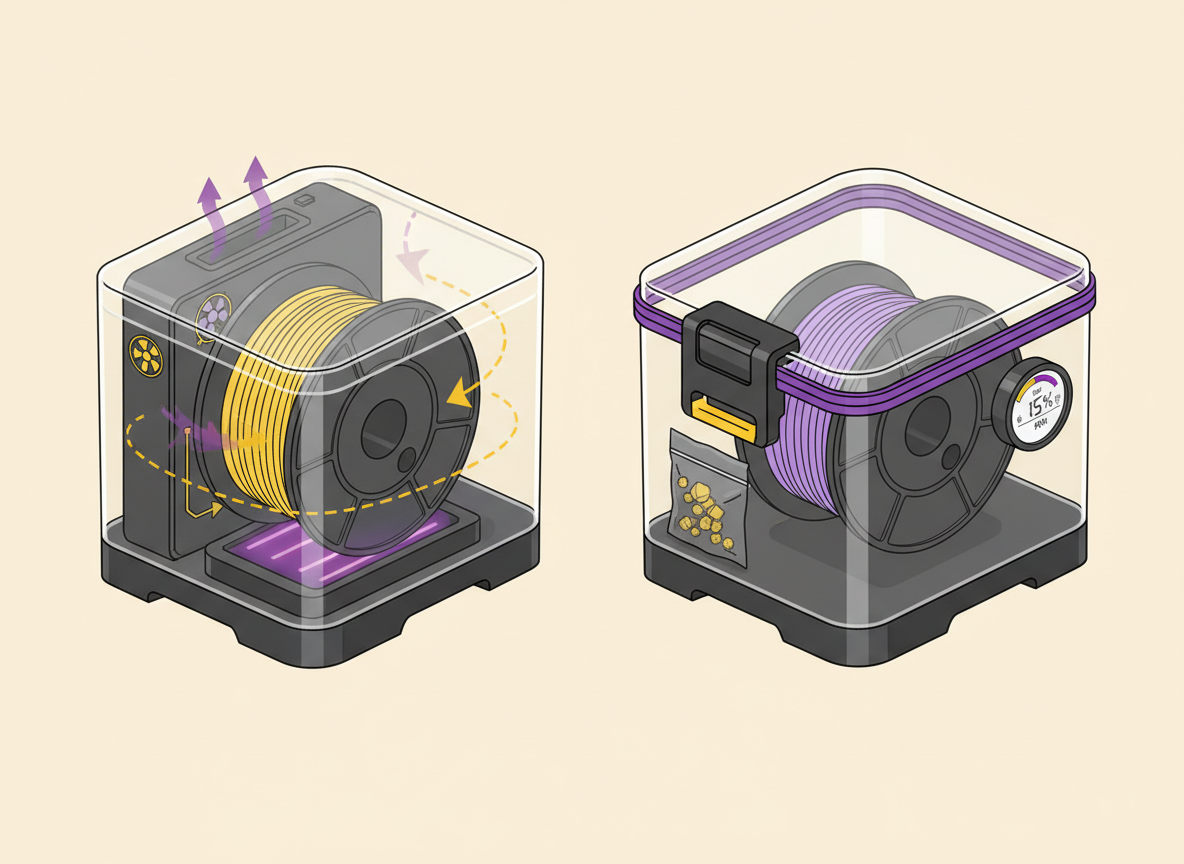
COMPARISON REPORT
A food dehydrator can work for some filaments, but the decision should start with the temperature your exact product needs—not with whichever device happens to be available.
QUICK VERDICT
Dedicated dryer
Usually the cleaner fit for frequent filament drying, spool handling and print-through workflows.
Food dehydrator
Can make sense when its temperature range, control and physical layout match the exact filament and spool.
FilamentFix rule: choose the drying target first. Then decide whether the device can meet it safely and consistently.
Filament dryer vs food dehydrator at a glance
| Factor | Filament dryer | Food dehydrator |
|---|---|---|
| Spool fit | Designed for filament spools | May require removing or modifying trays |
| Temperature range | Varies by model | Often limited to lower temperatures |
| Print directly from device | Often possible | Usually not without modification |
| High-temp materials | Only if the device reaches the required temperature | Often unsuitable if the required temperature exceeds its range |
| Best fit | Regular printing workflow | Low-temperature drying when range and control match the material |
SOURCE CHECK
What Prusa says about dehydrators
Prusa lists a food dehydrator as a possible drying method and notes that users often remove trays to make room for spools. It also warns that many dehydrators only reach relatively low temperatures, so the required drying temperature should be checked before buying or using one.
Which device fits your workflow?
DEDICATED DRYER FIT
- You dry filament frequently.
- You want a device physically designed for spools.
- You want to print directly from a heated enclosure.
- You prefer a simpler workflow with less modification.
DEHYDRATOR FIT
- Its range matches the exact product’s drying temperature.
- The spool fits safely away from heating components.
- You do not need to print directly from the chamber.
- You are mainly drying lower-temperature materials.
Decision path before spending money
01 · IDENTIFY
Confirm the exact filament product.
02 · VERIFY
Find the required drying temperature and duration.
03 · CHECK DEVICE
Make sure the real temperature range and spool fit match the target.
Do not buy the device first.
Choose the drying target first, then check whether the equipment can meet it safely and consistently.
Source
Prusa — Drying filament. Checked September 13, 2026.