
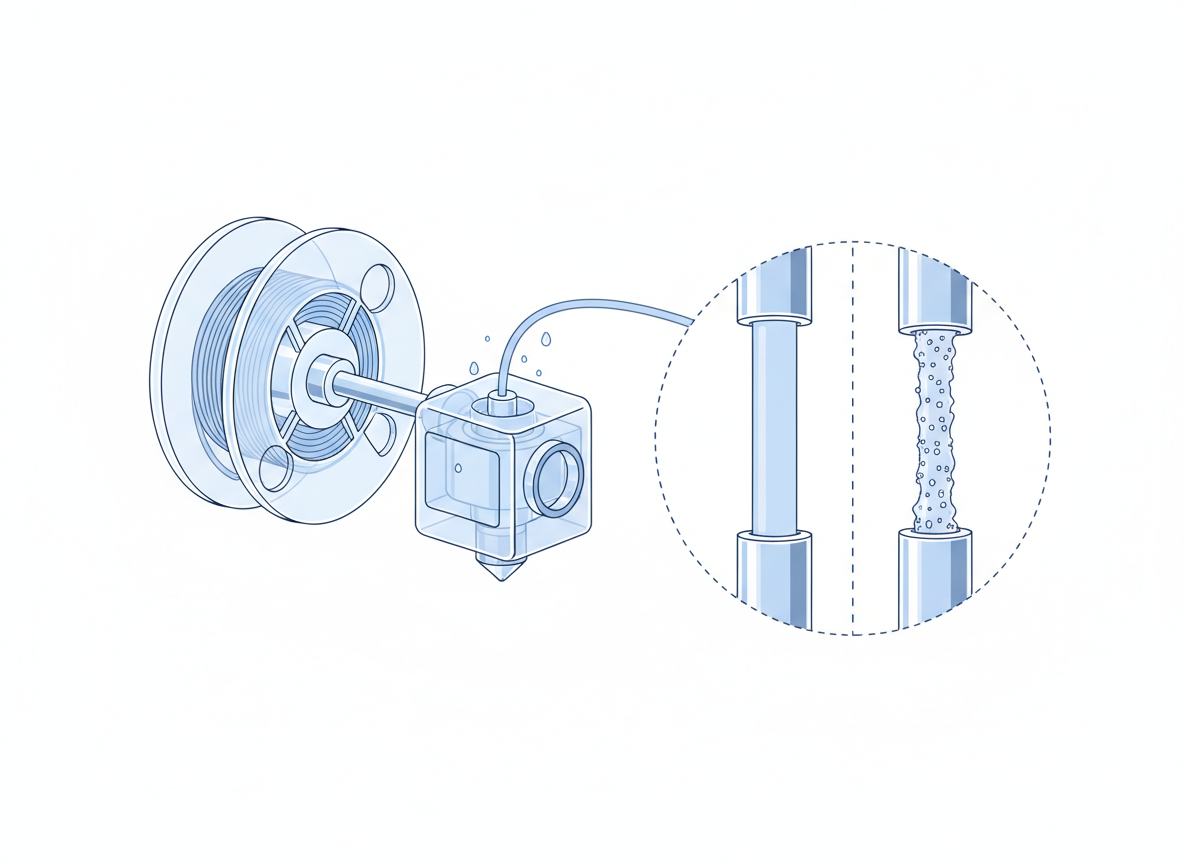
MOISTURE SYMPTOM REPORT
Wet filament can cause noisy extrusion, rough surfaces and inconsistent flow, but no single symptom proves moisture. The diagnosis becomes stronger when multiple clues line up with a credible exposure history.
FAST TRIAGE
Higher-confidence pattern
Repeated popping + bubbles or rough extrusion + credible humidity exposure.
Lower-confidence pattern
Stringing, weak layers or roughness by themselves without supporting history or nozzle clues.
9 signs your filament may have absorbed moisture
| Sign | How much weight to give it | Important alternatives |
|---|---|---|
| Popping or crackling | Meaningful clue | Contamination, abnormal feed |
| Bubbles / visible strand disturbance | Strong when repeated | Temperature, residue |
| Stringing | Weak alone | Temperature, retraction, travel |
| Rough surface | Possible | Flow, temperature, partial clog |
| Inconsistent extrusion | Possible | Clog, feed path, spool drag |
| Unexpected blobs / ooze | Supporting clue | Temperature, pressure, settings |
| Weak layer quality | Possible | Cooling, low temperature, flow |
| Long humid exposure | Raises prior likelihood | — |
| Improvement after correct drying | Strong before/after evidence | Only if unrelated settings stayed fixed |
SOURCE-BASED CLUE
Poor surface quality can be an early signal
Prusa’s drying guidance identifies poor model-surface quality as a common early moisture signal and says higher water content can also be associated with low layer adhesion, blobs and bubbling. Those symptoms still need context because several printer-side causes can look similar.
Controlled diagnostic sequence
01 · HISTORY
Material, time open and storage conditions.
02 · PURGE
Listen for pops and inspect the strand.
03 · ALTERNATIVES
Rule out obvious clog, temperature and retraction causes.
04 · RETEST
Dry only when justified, then repeat the same test.
A symptom is evidence, not a verdict.
Combine several clues before deciding that moisture deserves the next test.
Frequently asked questions
Does stringing mean filament is wet?
No. Stringing can come from nozzle temperature, retraction, travel behavior and material characteristics. Moisture becomes more plausible when stronger clues appear too.
Can a brand-new spool be wet?
It can arrive with enough moisture to affect printing, but packaging alone does not prove either condition. Use manufacturer guidance and a controlled diagnosis.
Should I dry filament every time quality drops?
No. If a controlled drying cycle does not address a supported moisture hypothesis, move to alternative causes instead of repeatedly heating the spool.
Source reference: Prusa Knowledge Base — Drying filament. Checked September 13, 2026.