
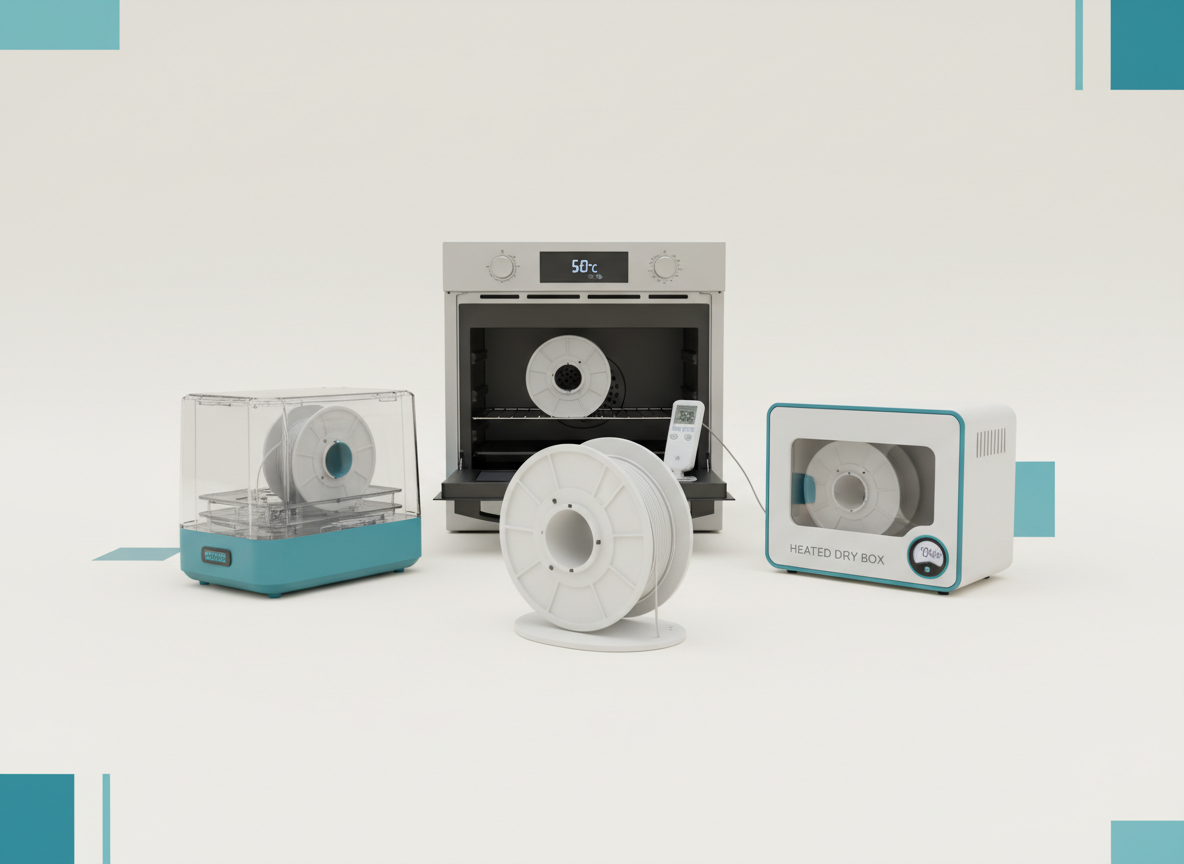
You do not need a dedicated filament dryer to troubleshoot every wet spool. Several alternatives can work, but they differ greatly in temperature control, safety and effectiveness. The goal is controlled warm airflow—not simply “more heat.”
Before you dry anything
First confirm that moisture is a realistic cause. Popping, crackling, bubbles, rough extrusion and a repeatable improvement after drying are stronger evidence than stringing alone. Use our wet-filament confirmation tests before changing multiple variables.
Method 1: Food dehydrator
A food dehydrator is one of the most practical alternatives because it is designed to move warm air for long periods. The main requirements are enough internal space for the spool and a temperature range appropriate for the material.
- Best for: users who dry multiple spools but do not want a dedicated filament appliance.
- Advantages: airflow, long run times and usually better low-temperature control than a household oven.
- Watch for: inaccurate thermostats and spool clearance.
See Filament Dryer vs Food Dehydrator for a full comparison.
Method 2: Household oven — only with careful temperature control
An oven can work in principle, but it is the easiest method to get wrong. Many household ovens cycle above and below the displayed temperature, and low-temperature accuracy may be poor. That can soften a plastic spool or deform low-temperature filament.
If you use an oven, verify the real temperature independently, preheat it before adding the spool, stay below the manufacturer’s recommended maximum and do not assume the control-panel reading is exact. For PLA in particular, a large overshoot can quickly become a problem.
Read Filament Dryer vs Oven before choosing this method.
Method 3: Heated dry box
A dry box with controlled gentle heat can combine drying and storage, but a simple sealed box with desiccant is not the same thing as an active dryer. Desiccant is excellent for keeping already-dry filament dry; it is usually much slower at removing substantial moisture from a wet spool.
If the box includes safe temperature-controlled heating and airflow, it can be useful for hygroscopic materials. Otherwise, use it mainly for storage after the spool has been dried.
Method 4: Heated printer enclosure or print bed — use only if the setup is designed for it
Some makers use a heated build plate with a spool covered by a vented enclosure. This can create a warm environment, but temperature uniformity and fire safety depend heavily on the printer and enclosure. It is not a universal recommendation. Never block printer ventilation or leave an improvised heated setup unattended.
Which method should you choose?
| Method | Temperature control | Airflow | Best use |
|---|---|---|---|
| Food dehydrator | Usually good | Good | Regular drying |
| Household oven | Variable | Variable | Occasional use with verified temperature |
| Heated dry box | Depends on model | Depends on model | Drying + printing/storage |
| Build-plate setup | Setup-dependent | Limited | Only carefully controlled setups |
Use the right temperature for the material
Do not use one temperature for every spool. PLA, PETG, TPU and Nylon tolerate very different heat levels. Use our filament drying temperature and time chart, then check the manufacturer’s instructions for your exact filament.
Drying is only half the job
After drying, let the spool cool in a dry environment and move it to sealed storage with desiccant. Otherwise a moisture-sensitive filament can begin absorbing water again. Our filament storage guide explains a practical setup.